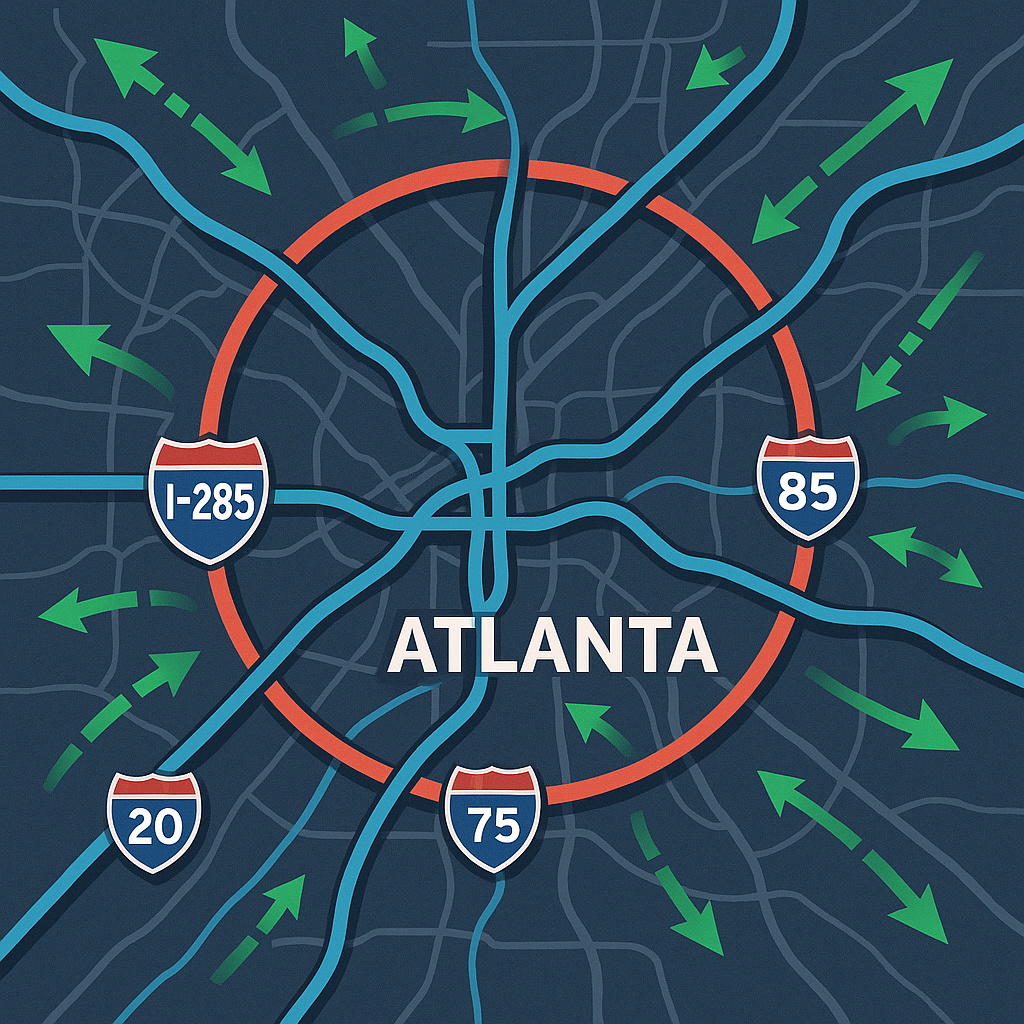
In the context of the rapid logistics sector, dealing with real-time flatbed tracking has become a competitive necessity. With Atlanta being promoted as a national freight hub, its intricate network of roads collectively called the Atlanta freight corridors sets the stage for carriers dealing with flatbed loads to face unique challenges. Carriers have to handle traffic jams at busy interchanges, new routes diverted due to rain, which fleet managers need the help of reliable embedded systems for live load monitoring that provide exact location, status updates in real-time, and insights that can be acted upon. Using the new tracking technologies and strategies based on data, shippers and carriers can cut back on delivery delays, improve customer satisfaction, and command full authority over their decontaminated cargo on every area of I‑285, the Perimeter Loops, and beyond.
The Importance of Live Load Monitoring
Flatbed transportation requires perpetual sight. Enclosed trailers provide complete encasement, while flatbeds are open to the environment and present dangerous freight — load shifts, theft, and environmental exposure. By means of live load monitoring, dispatchers attain:
- Improved Safety: The instant notifications for unexpected stops or excessive idling allow to act timely and prevent thefts thus ensuring full chain-of-custody.
- Better Compliance: The combination of electronic logging devices (ELDs) and GPS enables adherence to the duty-cycle records and audit trails.
- Active Issue Solving: The alerts on route deviations or unplanned delays being delivered before optimal channels or fixing problems with informing customers can help the teams to implement other solutions.
- Maximized Utilization: Knowing the load’s conditions, trucks as HMD Trucking can skillfully plan staff and get empty trailers to haul for profit on return trip.
By placing emphasis on real-time data rather than periodical check-ins, logistics teams can entirely overwrite the reactive nature of flatbed hauls and make them a smooth, predictable process.
Core Technologies Behind Real-Time Flatbed Tracking
The successful implementation of real-time flatbed tracking is based on a combination of interconnected technical achievements:
- GPS Visibility
The top-of-the-line satellite positioning is the fastest way to get location updates on a minute-to-minute basis, even when you are driving through tree-lined prolongations outside Atlanta. It is robust GPS solutions that fuel the entire tracking ecosystem. With their backup power, the transport companies can always be sure where they left the trailers. - ELD Integration
Merging GPS with ELD helps fleets in operating 100% and following their HOS regulations. This connection also integrates the ELDs in the truck journeys tracking platform and allows engine hours, fuel usage, and driver behavior metrics thus influencing ETA accuracy. - Carrier Dashboard
The user interface company a centralized maps, geofences, and custom report toggle. Dispatchers can sort by load status, check equipment availability, and all from a single pane of glass they can generate the exception-based dispatch alerts. - Real-Time Updates
Push notifications through SMS, email, or in-app messages each time a critical event occurs ensure to inform the stakeholders: customer docks arrival, unexpected detours, or equipment faults.
All mentioned above create a rhythmic pattern of information flow that changes raw GPS data to the right conclusions.

Navigating Atlanta Freight Corridors
Despite being a highly elaborate system, Atlanta’s highway network is also infamous for its extremely congested traffic:
- The Perimeter Loop (I‑285) surrounds the city, serving as a significant bypass but is usually clogged at rush hours.
- I‑285 bottlenecks, which is mostly encountered at the I‑20 interchange, if not adequately managed, can delay the trip by hours.
- Downtown Connector (I‑75/85) holds heavy commuter traffic that adds to freight facilitation.
- The access roads going to the Port of Atlanta and intermodal yards sometimes experience unforeseen surges mainly interconnected to vessel schedules and terminal operations.
Now to picture these problems and their solutions follow the below consideration:
| Corridor Segment | Challenge | Mitigation Strategy |
| Perimeter Loop (I‑285) | Heavy congestion | Dynamic rerouting via route optimization |
| I‑285 bottlenecks at I‑20 interchange | Frequent slowdowns | Pre-trip planning & real-time updates |
| Downtown Connector (I‑75/85) | Peak-hour delays | Off-peak scheduling & dispatch alerts |
| Port of Atlanta access | High traffic volume | Continuous load status monitoring & alt routes |
Treating each segment as a separate variable in a tactical equation rather than a fixed route assignment allows carriers to chip away at dwell times, reduce fuel wastage, and keep delivery schedules.
The success of a truck route instruction system is not only determined by a preset track but also by the detour from a specific set of predetermined variables. This will be done in the following modes:
Data-Driven Planning
Traffic, weather, and incident reports fed algorithms that allow drivers to choose the most reliable departure windows and detours.
Dynamic Rerouting
The situation where a key interconnection is permanently out of service due to an accident or construction, the automatically rerouted engines-a direct support from the ETA accuracy models-line find alternative sides or backroads to keep the flatbeds operable.
Proactive Dispatch Alerts
Rather than merely awaiting the signal from the driver, the modern systems will automatically create alerts if the attached trailer drops below the set speed or exits the planned geofencing. This visibility makes it possible for dispatchers to preempt the issues such as mechanical, bridge restriction or driver queries that will result in the delays that they save.
Integrated Carrier Dashboard
A good dashboard with thoughtful design will show all in-transit loads color-coded by on-time status, deviations, or nearing delivery windows. By applying filters for priority like traditional roads-inside the Perimeter Loop-crew will be able to prioritize intervention at critical points.
Collaborative Communication
The mobile apps for drivers to get real-time driving directions, while office teams can message shipment owners about the freight ensuring no tag is lost is the main advantage of collaborative communication that has to do with transparency through the chain of partnerships.
Continuous Improvement
The key to post-trip analyses is what they discover concerning persistent delays whether locations have a segment of a highway or a terminal that is a wait time. Then these will assist them in sorting out contract renegotiation, scheduling problems, and route optimization algorithms.
Using these techniques with live load monitoring will enable the fleets to remain flexible even if Atlanta traffic changes overnight — especially for those exploring dry van lease purchase jobs Atlanta, where dynamic conditions are part of the daily routine.

Best Practices for Mastering Real-Time Tracking
- Standardize Data Protocols: Ensure that all trailers and vehicles use the same GPS devices and ELD firmware. Inconsistent data streams cannot be detected.
- Set Clear Alert Thresholds: Identify your dispatch alert triggers clearly, for example—10 minutes of idle time, planned route exit? Align these with your operational priorities.
- Train Your Team: Real-time data is only as effective as the people who act on it. Hold regular workshops on how to interpret dashboard metrics and how to respond to exceptions.
- Audit and Calibrate: Periodically check the GPS for accuracy (especially near tall buildings) and test the geofence at key customer sites.
- Integrate with TMS and CRM: A supply chain perspective will highlight how tracking effective insights are impacting the billing, notifications to the customer, and performance reporting.
Future Outlook: Innovations in Live Load Monitoring
The technologies which are coming into the market will skyrocket real-time flatbed tracking to a level above:
- 5G and Edge Computing will abolish the latency thus providing sensor data in real-time.
- AI-Powered ETA Accuracy algorithms will learn from each trip, refining arrival estimates for specific corridors like I‑285.
- Blockchain-Based Load Status register immutability, increasing the trust in shippers, carriers, and receivers.
- Perimeter Loop SmartCity Initiatives if blessed with public traffic feeds enable more granular route optimization in Atlanta itself.
Once these progressions get integrated into the mainstream, the carriers which had the foresight to invest early will be rewarded with longer detention-free operations, smaller margins, and tighter customer loyalty.
Conclusion
To make the possible through the right technology, process, and people in choosing the right mix: real-time tracking of flatbed loads in the highly congested freight corridors Atlanta is dependent on. Utilizing live load monitoring, exploiting GPS visibility, integrating ELD data, and tactically managing the choke points such as the Perimeter Loop and I‑285 bottlenecks, fleets can turn unpredictability into a competitive weapon. Hence apart from ensuring shipments on time, they also create the operational strength that lets them get one step ahead in a market where every second and mile seems to be challenging.